Should we be worried that nearly half the Muslims in France privilege Islamic Law to the laws of the Republic and that the figures among Muslim youth born in France are much more radical? Or should we be relieved that half do not?
Does it change the meaning of the figures if we say ‘Islamic Law’ rather than ‘Sharia’?
The left, counting on their Muslim electorate, and a few Muslim associations, are striking back at an IFOP poll which shows Muslims in France are growing more and more radicalised and hostile to the host country. Some are saying this is Samuel Huntington’s revenge. Is the Clash of Civilisations paper proving true?
Paris, December 3, 2025, by S. G. Kazolias.
The counter-attack has a good dose of semantics and a large pitcher of hypocrisy.
The French IFOP poll published on November 18 showing a big increase in Islamist sympathies among Muslims in France has the French left and Muslim associations in an uproar. Four Muslim associations are even suing because they say the poll spreads “the poison of hate.”
They are challenging the wording but not the figures, as if the net increase in the penetration of radical Islam in France becomes less worrying with sweet vocabulary. The challenges to the study also carry a good dose of hypocrisy on the part of the critics who found nothing to complain about when the same poll was carried out in previous years and released figures they could live with.
The IFOP poll showed that nearly half the Muslims in France, 59% of the 15 to 24 year-olds, believe Islamic law, known as Sharia1, should be applied in countries where they live. Critics complain that the question asked concerned Islamic Law and not Sharia Law, yet ‘Sharia’ is the word used in Islam to name Islamic Law as defined in the Quran.
A full 44% say they privilege Islamic Law above the laws of the French Republic. That is 16 points higher than in 1995 and it should worry anybody interested in secularism, integration and equality. It is true that 31% say the laws should be adapted to the countries they live in, such as fasting during Ramadan, abstaining from alcohol and pork, or wearing religious garb, for examples.
It becomes problematic when men refuse to shake a woman’s hand or Muslim bus drivers refuse sit in the driver’s seat if the previous driver was a woman. There are parents who refuse to allow their daughters to go to mixed swimming pools during gym class or allow a male doctor to examine a female member of the family.
Forty-five percent of the young Muslim women questioned said they wear the Islamic head covering. Nearly half of those said they do so out of fear or social pressure, as if seeing the hair of a woman makes her impure. French laws imposing the equality of the sexes is rejected by half the Muslim population the study indicates.
A Hostile Muslim Identity
More concerning is the exponential growth among French born Muslim youth for an Islamic identity. Thirty-three percent of youth aged 15 to 24 expressed sympathy for a radical Islamic movement; a figure in constant progression with each generation of Muslims born in the country. There has also been a three-fold growth in females wearing the Islamic head scarf as youth adopt the dress code.
How does France prevent secession and communitarian conflict? Rather than trying to take the pollsters to court for the wording, one would think that the failure of integration of the Muslim migrant community and their offspring would be the topic of discussion.
“It is the constant generational increase which strikes hardest,” writes IFOP’s François Kraus, the director of the poll. “On nearly every indicator (religiosity, cultural practices, veils, refusal to mix (I.e. sexes, religions), rejection of science, primacy of religion, adhesion to Islamism) young Muslims show themselves to be systematically more rigorous and more radical than their elders.”
The Muslim associations suing say the pollsters “focused on the minority results to put forward in order to create a polemic” and of “founding it on leading questions.” For them, the poll distills “the poison of hate in the public sphere” and reinforces “amalgames.”
The rector of the Great Mosque of Paris, Chems-eddine Hafiz, said: “By asking bad questions, you always end up fabricating the fears you pretend to measure.”
IFOP is also suing. This time two members of parliament from the hard left Les Insoumis party who accused the posters of doing “a rigged job on the orders of a foreign power as part of an influence operation” with the intention of frightening people and favouring the extreme right. Poll director Francois Kraus stresses that Muslims make up half the Insoumis electorate. This may explain that, as the French say.
One of the Insoumis parliamentarians, Paul Vannier, wrote on X that that IFOP has “an extreme right wing Islamophobic agenda.
“They interview anyone and everyone haphazardly, with a ridiculous sample size, and then they pretend that all this gruel describes society when they are only twisting it to construct an anxiety-inducing narrative that flatters the ideology of the far right.”
Kill the Messenger. Bury the Message.
Since the poll was published, IFOP and its employees have received hate messages and death threats. The review which ordered the study, Ecran de veille, has also received messages of hate and death threats, their offices were forced to close and a director was put under police protection in Switzerland.
IFOP first began these polls for the center left newspaper, Le Monde, back in 1989, using the same questions. “One month ago (in October) we carried out a poll on Islamophobia for the Great Mosque of Paris,” says IFOP’s Kraus. “At that time LFI (the hard left Insoumis party) hailed the investigation. Yet we used the same method, the same sample of the population and today they criticize our methodological tools”
IFOP General Director, Frédéric Dabi, said: “I regret these accusations which have put part of my team in danger.” He accuses the two members of parliament of putting “a target on their back.” He insisted that 80% of the questions are historic and have been used for 36 years and the study was based on the same population sample.
The Islamist death threats are being taken seriously. In 2020, a French secondary school philosophy teacher, Samuel Paty,2 was decapitated in front of his school by a Chechen refugee after an Islamist online campaign against his teaching.
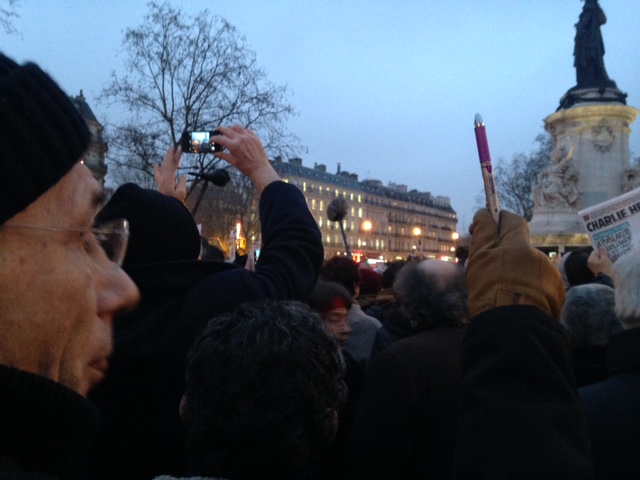
Others see the ghost of Charlie Hebdo in the death threats and don’t understand how Les Insoumis and others on the left can be so cavalier in their accusations. Centrist deputy Caroline Yadan was one of some 40 parliamentarians who made a statement defending IFOP and Ecran de veille. “Targeting journalists is aiming at democracy and the Republic,” she wrote on X. “While the bloody attack against Charlie Hebdo remains in our memories, each of us measures the gravity of such acts, susceptible of constituting a crime of inciting to murder and putting the lives of others in danger.”
The far left and its allies, who promote tolerance, respect for equality of the sexes and LGBTQ rights, should be more concerned that half their electorate says openly it does not share the values they profess. Changing the words or telling us the glass if half full when it is the half empty part which is a threat, will not change reality.
France’s attempt at integration has not worked. The youth of its recent Muslim immigration population are more and more hostile to the host country and its way of life. Rather than attacking the messenger, France would be better served if the leftists dealt with the message. Unless of course, what Insoumis leader, Jean Luc Melanchon, meant by the “creaolization” of France, is a country of hostile enclaves of Islamization which will inevitably lead to a violent clash of civilisations.
Don’t forget: Please leave a comment. A cup of coffee or a slice of pie would be nice too: paypal.me/SocratesGeorge
- From Wikipedia: Islamic law, also known as Sharia, is a system of religious law derived from the Quran and the Hadith (sayings and actions of the Prophet Muhammad). It guides various aspects of a Muslim’s life, including personal conduct, family matters, and social justice, and is interpreted through a process called fiqh by Islamic scholars. ↩︎
- From Wikipedia: On 16 October 2020, Samuel Paty, a French secondary school teacher, was attacked and killed in Éragny, Val-d’Oise, Île-de-France, France, by an Islamic terrorist. The perpetrator, Abdoullakh Abouyezidovich Anzorov, an 18-year-old Russian Muslim refugee, i.e. Chechen, killed and beheaded Paty with a cleaver, and was shot and killed by police minutes later. A social media campaign against Paty was linked to his subsequent murder. One of Paty’s students had alleged that in a class on freedom of expression, he had shown his students Charlie Hebdo’s 2012 cartoons depicting the Islamic prophet Muhammad, including an image of Muhammad naked with his genitals exposed. Continued in Wikipedia ↩︎
 KazoDaily