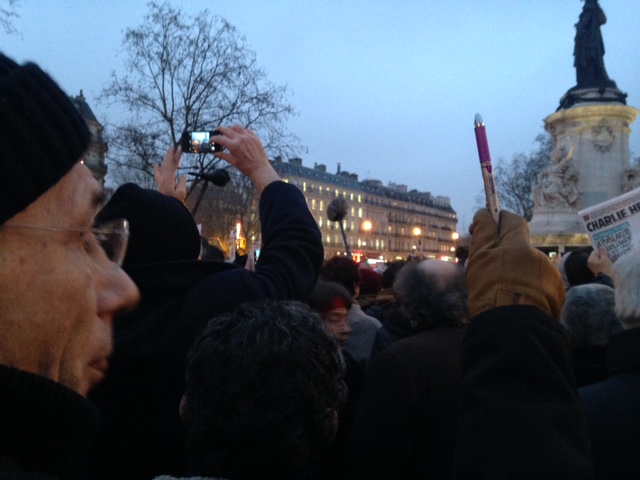
Paris, April 2, 2025, by Socrates George Kazolias

The French lower Court decision March 31 to bar the 2027 presidential election favorite, Marine Le Pen, from running has angered millions throughout the country, sparked fears of social unrest and widespread political condemnation, including from the far left.

The ripples have been felt to the summit of the state and the system looked desperately on April 1 for a way to backtrack, if not stave off, at least put off, a social confrontation.

The  Appeals Court, which usually takes two years to hear a case, said it will begin the trial next January for a decision upholding or invalidating the lower court’s ruling in June 2026, which would give Marine Le Pen, and her far right National Rally party, if the first ruling is overturned or reduced, nine months to prepare for the 2027 ballot.
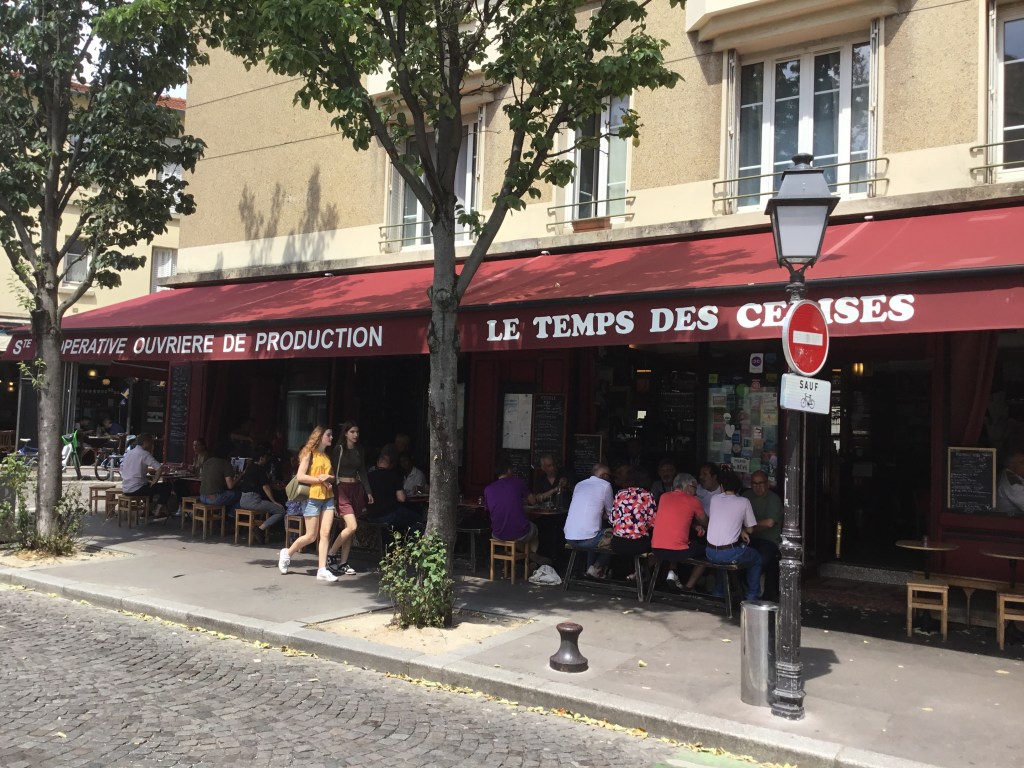
Paris, June 28, 2024, by Socrates George Kazolias

Le temps de Cérises, photo @kazolias

Over the past 40 years, the working class population of Paris has been gradually pushed further and further outside of the city as the new rich take over. One of the last areas in southern Paris is holding on by a thread: La Butte Aux Cailles.

I started coming to Le Temps Des Cérises restaurant when it was first opened by a collective of anarchists in 1976. At the time La Butte aux Cailles was a run-down, working-class area, with cheap hotels that rented rooms to North Africa immigrant workers, a PMU horse betting café and a couple of bars.

Paris, October 12, 2023, by Socrates George Kazolias:

A Bouquiniste near le Pont Neuf who will be dismantled before the games. (Kazolias)

Who can imagine Paris without those green boxes fixed to the walls on both banks of the river Seine where vendors, called Bouquinistes, sell rare and old books, ancient periodicals, and posters? They are as iconic to Paris as Notre Dame, the Louvre, or the Eiffel Tower. To the dismay of the Bouquinistes, the book stalls must go before the Olympic Opening Ceremony next July.

Paris: They are getting too old, or too fat, to build barricades, their hands too soft to dig up cobblestones, but they still have the voice to sing to the glory of those who fought to defend the world’s first workers democracy, a two month long experiment in 1871 which ended in a blood bath: The Paris Commune.

Young and old celebrate the Commune

Every September for the past 15 years, the Association “Friends of the Paris Commune 1871” organizes a block party at Place de La Commune de Paris – 1871 (where else?) in the 13th district of Paris. They drink blood red wine made deeper with cassis, curse the Versaillais and Adolphe Thiers who sent the French Army to massacre the people and generally enjoy a Fall afternoon.

The war which led to the destruction of Libya was unnecessary, launched on false pretense and disastrous. This is the conclusion drawn from reading the UK parliamentary report on the War that destroyed Libya and destabilized a continent.

images-2
Protesters have taken to the streets the pas four months.

Gas stations ran dry last week when unions blocked the refineries.  Other employees threatened to shut down nuclear reactors.  Public transport is expected to grind to a halt this week.  Police, teachers, prison guards and more are joining the movement. All of this to protest a mild labor reform law aimed at reducing unemployment.

President Hollande insists he will not back down even though violence in the streets, despite a state-of-emergency, has the government fearing tourists will stay away this summer.

It is truly a case of ‘The Cid‘ in which there is no honorable way out for all sides meaning the worst is possible.

The debate in France this week centers on Islamophobia and is sparked by the publishing of two books. The first by Charb (1), one of the artists killed in the January 7 Charlie Hebdo attack and the second by a Journalist, Caroline Fourest(2).

Both reject attempts to stifle debate on Islam by labeling any who criticize the religion of Mohammed as “Islamophobes.” They write that in reality, the crusade against Islamaphobia is an attempt to weaken secularism; to put religion above the laws of the land.

The man who got on a Parisian bus with me Wednesday was an Arab who had not shaven in four days. He had dark olive skin and kinky black hair and was visibly unbalanced: drugs? He sang to a popular tune “I’m going on Jihad. Won’t you come on Jihad with me too?” He risks five years in prison and a 75 thousand euro fine.

In the first six days after the massacre at Charlie Hebdo, 54 people were charged with “apology for terrorism” under a tough law voted in the French parliament last November which can jail someone, if they express their “support for terrorism” on the electronic media: FaceBook, Twitter etc., to up to seven years and fine them 100 thousand euros .

France’s “war on terrorism” has begun. The new law allows the “apologists” to be brought before a judge as soon as they are arrested in a process called “comparution immediate”; that is without time to prepare a defense.  It is a law for a time of war.

They came in their hundreds of thousands. Jews, Muslims (although fewer than hoped for), Christians and atheists: Students, workers, the unemployed and the bourgeoisie. They said “I am Charlie.” “I am Ahmed.” (the policeman executed at Charlie Hebdo). “I am a Jew.” Or, they just said nothing.

They were anarchists, communists and ultra nationalists, social democrats and conservatives. There were also islamophobes and anti-Semites. The one thing that united them all was their refusal to yield to fear and their desire to keep the freedom to think what they want and to be able to say it in public without facing obscurantist violence. This coming together of those who want the right to disagree with each is extraordinary. France, which gave us the enlightenment, 1789 and the Universal Declaration of Human Rights is still Une Grande Nation.

Were the Wades ready to call in European troops to back their bid for a new ‘monoarchy’? According to influential French lawyer and longtime Wade family confident Robert Bourgi, the president’s son asked him, on June 27, to get the French Army to intervene in the country.